30 June 2026

The blockchain transparency – what does it mean?

An inherent feature of blockchain technology is data transparency. Data stored in the network is confirmed (in terms of its integrity, immutability, and timeline), and once recorded in a block, it is available to all network nodes. In this context, it is crucial to understand transparency as an element that enables verification of the ledger's actual state. Data that is not available to all network participants cannot be fully confirmed—thus, consensus among all participants regarding the entry of specific information requires its sharing within the network. Sharing information about an event, in turn, significantly affects its confidentiality.

Translating this to the capital market (or, more broadly, the financial market), a dilemma arises, requiring the need to balance this transparency with the requirements of confidentiality, data protection, and professional secrecy. The collaboration among multiple entities within a single distributed blockchain network means assessing the sensitivity of data stored on the network.

At this stage of the analysis, we are dealing with another "variable." In general, a DLT network need not be public. So-called private networks allow for restricting access to the ledger's state to identified entities. This, in turn, means that not everyone will have access to the data. Therefore, even if transparency elements inform everyone about an event, the information will ultimately remain within a trusted circle of identified entities. This model was implemented in the CSDonDLT project. As a result, access to the network and any data related to OTC transactions is restricted, even though the data itself does not contain sensitive information, including information identifying the parties.

However, to understand the issue of blockchain network transparency, it is worth examining how certain facts can be confirmed with access to the network (in this case, public networks). I will illustrate this using the example of the first Siemens bond issue, which was widely reported in the media several years ago.

The announcement

A few years ago, Siemens, the multinational technology company, made headlines with the announcement of the first digital bond issued on a public blockchain in accordance with Germany’s Electronic Securities Act (eWpG).

Siemens portrays this bond issuance as pioneering in the digital transformation of capital and securities markets. By issuing the bond on a public blockchain, Siemens claims to have reduced the need for paper-based global certificates and for central clearing, a major benefit of the blockchain-based issuance process. In addition, the bond can be sold directly to investors without needing a bank to function as an intermediary, further streamlining the process.
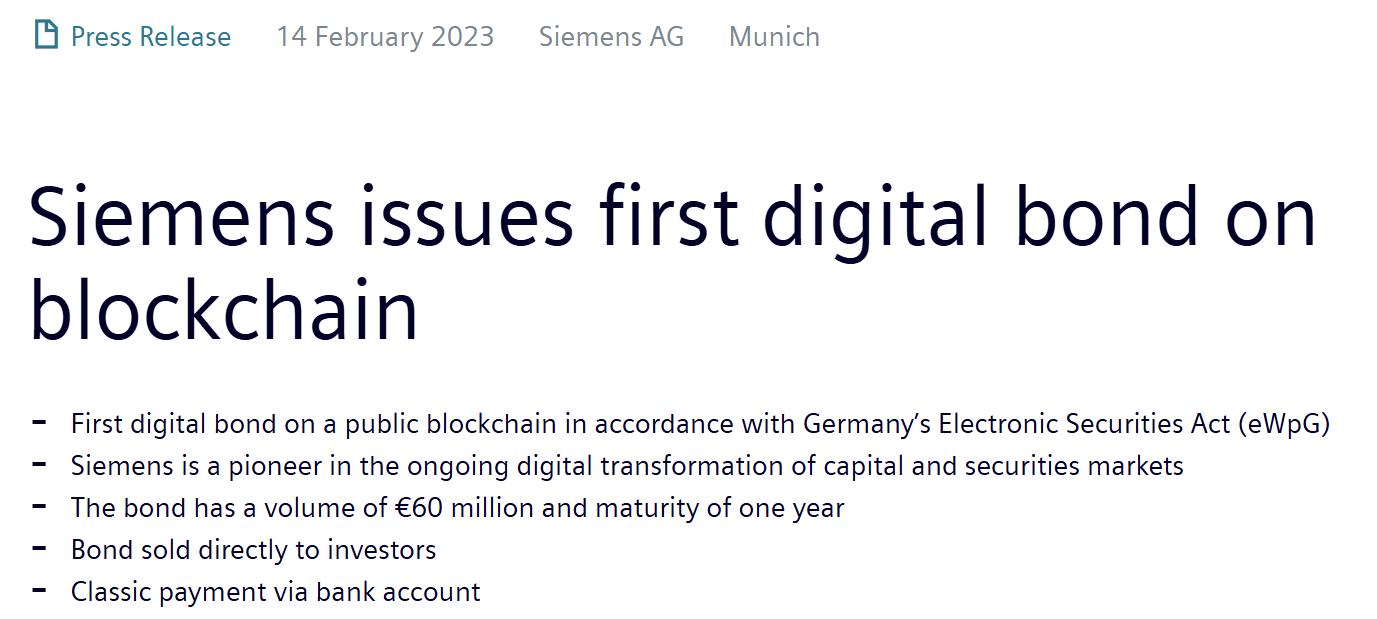
Source: Siemens Press Release, Siemens Issues First Digital Bond on Blockchain,

https://press.siemens.com/global/en/pressrelease/siemens-issues-first-digital-bond-blockchain

(accessed 30 June 2026)

Siemens' blockchain-based bond issue generated significant media attention, with many news outlets hailing it as a breakthrough moment for the financial sector.

The emergence of curiosity

Despite the buzz surrounding Siemens' blockchain-based bond issue, finding detailed technical information about the issue hasn't been easy. However, recent reports have revealed that the bond was registered on the Polygon network, a public blockchain compatible with EVM. However, no official information about the smart contract address was provided, which would ultimately allow investors to verify the bond's authenticity and ensure it wasn't forged.

The lack of technical information about Siemens' blockchain-based bond issue has sparked curiosity among blockchain enthusiasts and investors. Some Twitter users contacted Siemens representatives to inquire about the blockchain used for the issue and the smart contract address, but the company remained silent. In a tweet on February 14 2023, Simon Friedle, a Siemens representative, stated that the transaction was executed through Polygon. However, when asked about the smart contract address, Friedle stated that the issue was a private placement with investors and that he could not disclose further information.

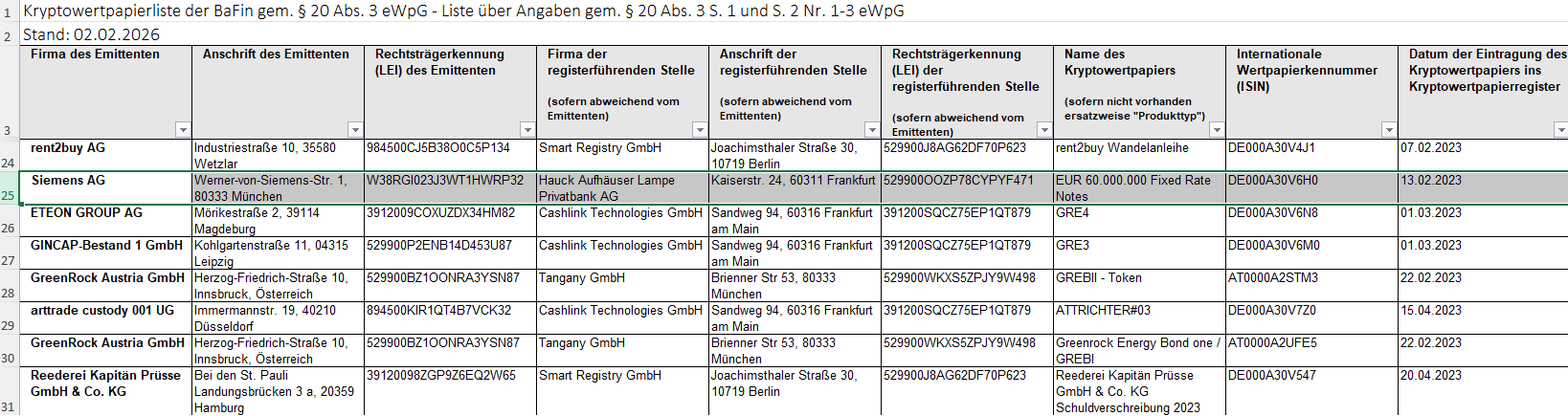
Through extensive research and reaching out to various sources, including the Federal Financial Supervisory Authority (BaFin), one can confirm the issuance’s ISIN code and its listing on BaFin’s list of crypto assets.

The list of new crypto assets under BaFin supervision can be found here:

Source: Federal Financial Supervisory Authority (BaFin), List of Crypto Securities (XLSX file),

https://www.bafin.de/SharedDocs/Downloads/DE/Liste/dl_Liste_Kryptowertpapiere.xlsx?__blob=publicationFile&v=9

((accessed 30 June 2026).

Knowing the asset ISIN, the rest should be more straightforward unless, of course, Siemens decides to issue a token without an ISIN reference.

The nature of transparency in all its glory

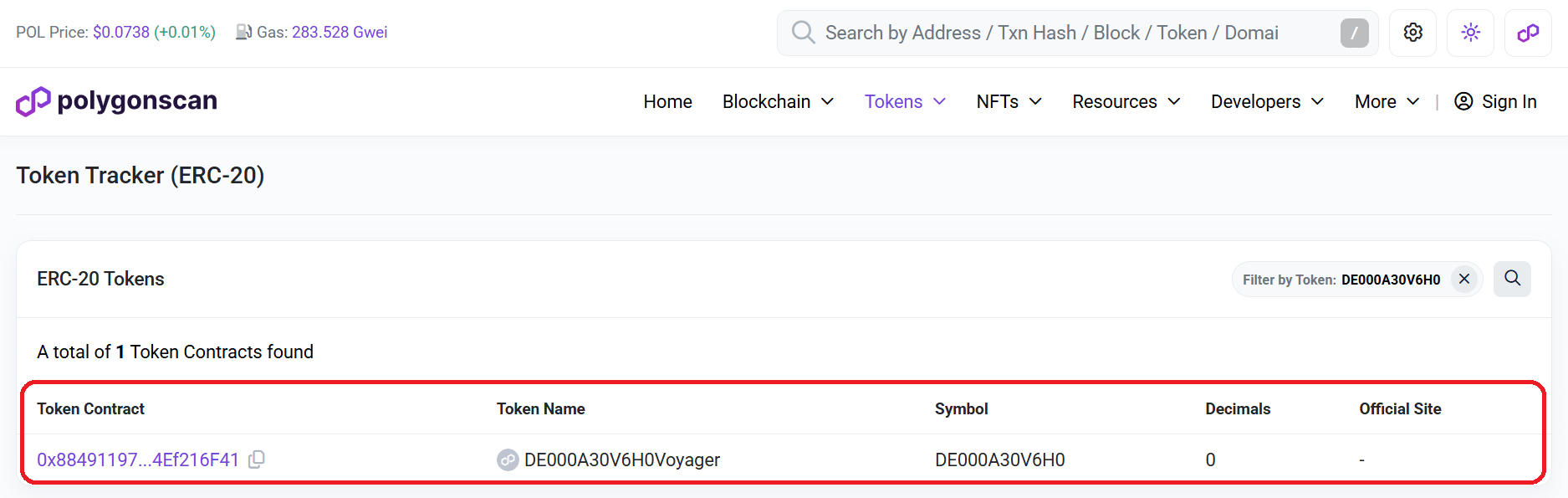
With the ISIN (DE000A30V6H0) in hand, the next step is to use PolygonScan, a blockchain explorer on Polygon, to find information about the digital bond. The simplest way is to use the ISIN as the token name. It seems natural that the ISIN would be mapped to the token as its identifier.

Source: PolygonScan,

https://polygonscan.com/tokens?q=DE000A30V6H0

(accessed 30 June 2026)

So the contract address was revealed: 0x884911971d1E3FEc48227c944bd00aa4Ef216F41, together with the exact token name — DE000A30V6H0Voyager.

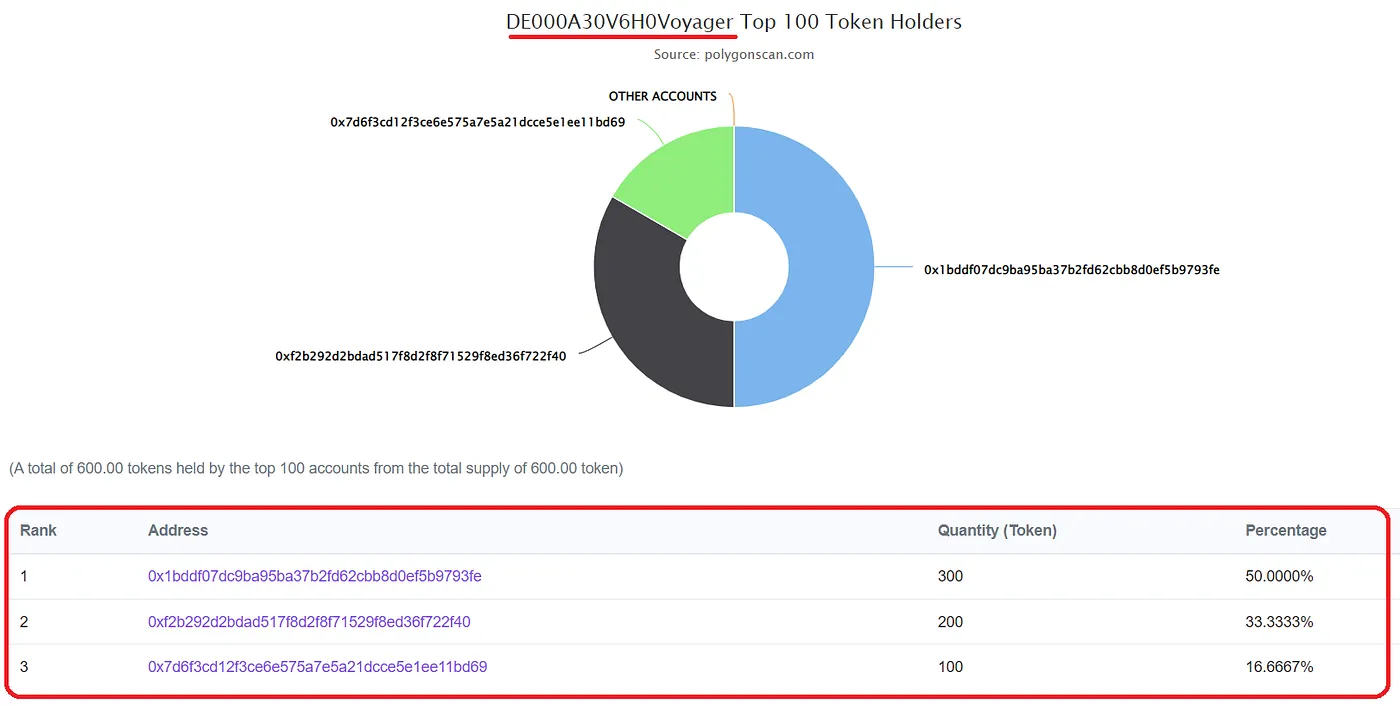
After locating the smart contract address on the Polygon network, we investigated the details of the Siemens bond issue in more detail. At that time, it turned out that only three investors were involved in the issue, and there were no additional transactions. This suggests that the issue may have been primarily intended for marketing or promotional purposes, rather than a significant change in the use of blockchain technology for bond issuance.

Source: PolygonScan,

https://polygonscan.com

(accessed 05 May 2023)

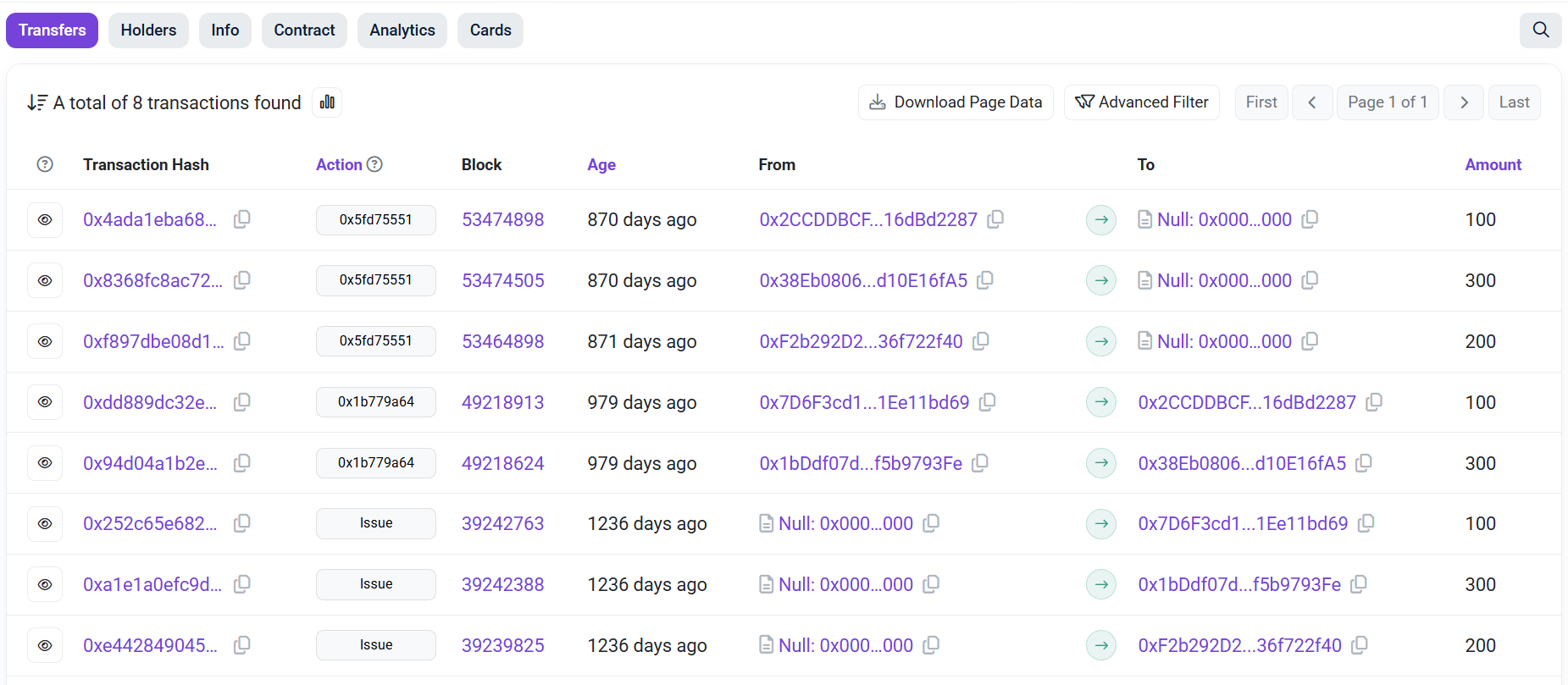
Those were the data discovered a few years ago. If you check the token data today, the PolygonScan shows you that no one is holding Siemens bonds. It is not surprising, as it was a one-year bond; the current issuance volume is expected to be 0. 

But in fact, some more interesting things can be traced.

Source: PolygonScan,

https://polygonscan.com/token/0x884911971d1E3FEc48227c944bd00aa4Ef216F41#transactions

(accessed 30 June 2026)

Now everyone can view the full history of Siemens' bond issuance. The tokens were issued on February 13, 2023, and redeemed a year later on February 13, 2024. Initially, the tokens were issued to three institutions, but on October 27, 2023, two investors transferred all their tokens to two other entities. Nothing can be hidden - all operations are fully transparent.

This is what transparency is all about.
 

Summary

The Siemens bond case demonstrates that blockchain transparency is not merely a theoretical feature of distributed ledger technology but a practical mechanism that enables independent verification of on-chain facts. At the same time, the example highlights that transparency should not be understood as the unrestricted disclosure of all information. In financial markets, transparency must coexist with requirements relating to confidentiality, investor privacy, business secrecy, and data protection.

This is precisely where permissioned DLT environments, such as the CSDonDLT project, provide an important perspective. CSDonDLT demonstrates that transparency can be implemented in a selective and proportionate manner. Market participants can verify the existence, status, and integrity of transactions recorded on the ledger, while access to sensitive transactional data remains restricted to authorized entities. In other words, transparency is preserved where necessary for trust and market integrity, while confidentiality is maintained where required by law and regulation.